

Family death lawyer: 4 Critical Steps to Justice
Why Families Need a Wrongful Death Lawyer After Losing a Loved One
A family death lawyer, or wrongful death attorney, helps surviving family members seek justice and financial compensation when a loved one dies due to someone else’s negligence or wrongful actions. Losing a family member is devastating, and when that death was preventable, the pain is compounded by financial hardship from medical bills, funeral costs, and lost income.
A wrongful death lawyer handles the entire complex legal process, which includes:
- Filing claims on behalf of eligible family members.
- Proving negligence by gathering evidence like police reports and medical records.
- Calculating all damages, including lost income and loss of companionship.
- Negotiating with insurance companies for a fair settlement.
- Representing the family in court if a trial is necessary.
- Managing all legal deadlines, such as the statute of limitations.
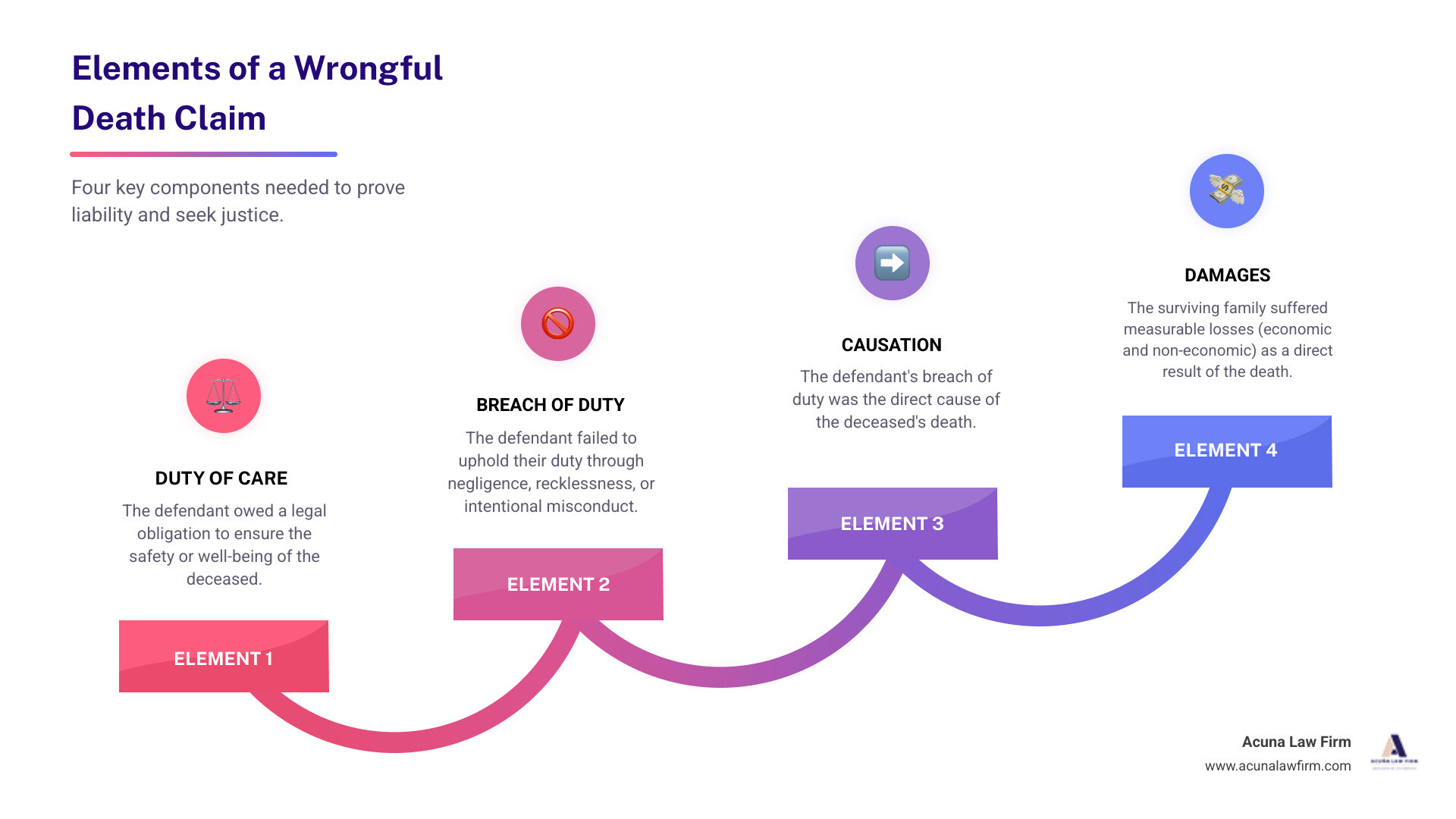
These claims arise from incidents like car accidents, medical malpractice, workplace accidents, and defective products. To succeed, a lawyer must prove four key elements: the defendant owed a duty of care, they breached that duty, this breach directly caused the death, and the family suffered measurable damages as a result. Understanding your rights is the first step toward holding the responsible parties accountable.
Defining Wrongful Death: What It Is and Who Can File
A wrongful death claim is a civil lawsuit filed when someone’s negligence or misconduct directly causes another person’s death. While no amount of money can replace a loved one, these claims hold responsible parties accountable and provide crucial financial support to the family left behind. At Acuna Law Firm, we see these claims as a vital type of Lesiones Personales (personal injury) case designed for fatal incidents.
Common Causes of Wrongful Death
Wrongful deaths can result from many types of negligence. Some of the most common causes include:
- Vehicle Accidents: Fatalities caused by negligent drivers, defective auto parts, or irresponsible trucking companies.
- Medical Malpractice: Deaths resulting from surgical errors, misdiagnosis, anesthesia mistakes, or other failures in professional medical care.
- Workplace Accidents: On-the-job deaths due to unsafe conditions, machine-related incidents, or falls, particularly in high-risk industries like construction and transportation.
- Defective Products: Fatalities caused by unsafe products, such as dangerous drugs, faulty auto parts, or hazardous children’s toys.
- Other Incidents: Claims can also arise from police misconduct, premises liability (unsafe property), or criminal acts.

Who is Eligible to File a Claim?
The rules for who can file a wrongful death claim vary significantly by state. For general information, you can consult resources like the Cornell Law School’s overview of wrongful death. In many states, including Oklahoma, the right to file is typically granted to:
- The Personal Representative: An executor named in the will or an administrator appointed by the court, who files on behalf of the estate and family.
- Surviving Spouse: Almost always considered a primary beneficiary.
- Children: Both biological and legally adopted children.
- Parents: Especially for a minor child, but sometimes for an adult child if no spouse or children exist.
- Other Next of Kin: In some cases, siblings or other dependent relatives may file if no immediate family members are eligible.
State laws, like those in New York, can be very specific, often allowing only the personal representative to initiate the action. If multiple eligible family members file, a court will typically consolidate the lawsuits into a single case. A skilled family death lawyer can steer these complexities, ensuring all parties are properly represented. For more details on eligibility, you can refer to our Wrongful Death: A Guide for Survivors.
The Financial Side: Compensation, Damages, and Insurance
A wrongful death creates an immediate financial crisis on top of the emotional devastation. Wrongful death claims are designed to provide financial support to families while holding responsible parties accountable. At Acuna Law Firm, we handle various Áreas de Práctica and can help you understand the compensation you may be entitled to receive.
Types of Compensation You Can Seek
A lawsuit aims to recover damages reflecting the full scope of your family’s loss. These are divided into two main categories:
- Economic Damages: These cover tangible financial losses, including medical bills, funeral and burial expenses, lost future income and benefits, loss of inheritance, and the value of services the deceased provided (like childcare or home maintenance).
- Non-Economic Damages: These address intangible losses that are just as real, such as the loss of companionship, affection, guidance, and support. They also may include compensation for the conscious pain and suffering the deceased experienced before their death.
In some cases where the defendant’s conduct was particularly reckless or intentional, punitive damages may be awarded to punish the wrongdoer and deter similar behavior in the future. It’s important to know that some states, like Tennessee, may cap non-economic damages. An experienced family death lawyer can explain how these apply to your case.
What if the At-Fault Party Has No Insurance?
This is a common fear, but it doesn’t always mean there is no path to recovery. An experienced lawyer will explore all options:
- Uninsured/Underinsured Motorist Coverage: Your own or your loved one’s auto insurance policy may provide coverage.
- Asset Investigation: The at-fault party may have personal assets (real estate, bank accounts, etc.) that can be used to satisfy a judgment.
- Third-Party Liability: Other parties may share responsibility. For example, a mechanic, a municipality, or a trucking company could be partially liable and have their own insurance.
- Employer Liability: If the person was working at the time of the incident, their employer might be held vicariously liable and covered by business insurance.
Our firm leaves no stone unturned in investigating every possible source of recovery for your family.
Key Distinctions: Wrongful Death vs. Survival Claims and Murder
Not all legal actions following a death are the same. Their purpose, who files them, and the damages sought can vary significantly. Understanding these differences is crucial.
| Feature | Wrongful Death Claim | Survival Claim | Murder (Criminal Case) |
|---|---|---|---|
| Purpose | Compensate surviving family for their losses | Recover damages for the deceased’s losses before death | Punish offender, uphold public order |
| Court Type | Civil Court | Civil Court | Criminal Court |
| Who Files | Deceased’s personal representative on behalf of family | Deceased’s personal representative on behalf of estate | The State (Prosecutor) |
| Damages Awarded | Lost financial support, companionship, services, funeral expenses, etc. | Deceased’s pain & suffering, medical bills, lost wages (before death) | Fines, imprisonment, death penalty (no compensation for family) |
| Burden of Proof | Preponderance of the evidence (more likely than not) | Preponderance of the evidence | Beyond a reasonable doubt (very high standard) |
A Wrongful Death Claim focuses on the losses suffered by the surviving family, such as lost financial support and companionship. In contrast, a Survival Claim is brought on behalf of the deceased’s estate to recover for losses the person experienced before death, like medical bills and conscious pain and suffering. In many states, these two civil claims are filed together.
Murder is a criminal charge brought by the state to punish the offender. A key difference is the burden of proof: a criminal case requires proof “beyond a reasonable doubt,” a much higher standard than the “preponderance of the evidence” used in civil cases. This means a wrongful death claim can succeed even if the defendant is acquitted of criminal charges. An experienced family death lawyer can clarify which claims apply in your state. For more information, see our guide on the Settlement of Wrongful Death and Survival Claims.
Navigating the Legal Maze with a Family Death Lawyer
The legal process after a wrongful death is complex and overwhelming, especially while grieving. This is when a skilled family death lawyer becomes essential. Our team, including experienced attorneys like Mariano Acuña, is here to shoulder the legal weight so you can focus on healing.

The Role of a Family Death Lawyer
A family death lawyer is your advocate, investigator, and negotiator. We handle every aspect of your case: gathering evidence like police reports and medical records; hiring expert witnesses such as accident reconstructionists and economists; managing all paperwork and deadlines; and aggressively negotiating with insurance companies to secure full compensation. We calculate all damages, from lost wages to the immeasurable loss of companionship. If a fair settlement isn’t reached, our trial attorneys, like Alexa Acuña, are prepared to represent you in court. Above all, we provide compassionate support, explaining each step and treating you like family.
Critical Deadlines: Understanding the Statute of Limitations
You cannot wait indefinitely to file a wrongful death claim. Every state has a statute of limitations—a strict deadline that, if missed, will permanently bar you from seeking compensation. These deadlines vary dramatically: Tennessee generally allows only one year, while North Carolina, Florida, and Oklahoma typically allow two years. However, exceptions for medical malpractice or cases involving minors can change the timeline. Acting quickly is critical to preserve evidence and protect your legal rights. If you are unsure about your deadline, contact a lawyer immediately. Learn more about Deadlines for filing wrongful death claims.
State-Specific Variations in Wrongful Death Law
Wrongful death laws are not uniform across the country. Each state has its own rules regarding who can file, what damages are recoverable, and how compensation is distributed. For example, New York Wrongful Death Law is restrictive, while Florida defines eligible “survivors” more broadly. Tennessee caps certain non-economic damages. Oklahoma has its own unique provisions for claimants and damages. These variations directly impact your case’s outcome, making it vital to hire a local family death lawyer who understands your state’s specific legal framework and can maximize your family’s recovery.
Frequently Asked Questions about Wrongful Death Cases
We know you have many questions during this difficult time. Here are answers to some of the most common ones we hear.
How long does a wrongful death case typically take to resolve?
The timeline varies from a few months to several years. Key factors include case complexity, whether liability is disputed, and if the case settles or goes to trial. A straightforward case with clear liability might resolve in 6-12 months, while a complex medical malpractice case that goes to trial could take two years or more. A skilled family death lawyer will work to resolve your case as efficiently as possible without sacrificing the compensation you deserve.
What evidence is needed to prove a wrongful death claim?
A strong case is built on comprehensive evidence. Your lawyer will gather and analyze numerous documents to prove duty, breach, causation, and damages, including:
- Police, accident, and autopsy reports.
- Medical records and bills.
- Witness testimony from eyewitnesses, family, and coworkers.
- Expert analysis from accident reconstructionists, medical professionals, and economists.
- Video footage, photographs, and physical evidence.
- Employment and financial records (tax returns, pay stubs) to prove lost income.
What are the best practices for handling claims involving minors?
When a child is a beneficiary, the law provides extra protections to safeguard their financial future. This typically involves:
- Court Approval: A judge must approve any settlement to ensure it is fair and in the child’s best interest.
- Guardian ad Litem: The court may appoint an independent advocate to represent the minor’s interests during the settlement process.
- Structured Settlements or Trusts: The money awarded to the minor is usually placed in a protected trust or structured settlement. This ensures the funds are managed responsibly and are available for the child’s future needs, such as education and living expenses, after they reach adulthood.
An experienced family death lawyer can steer these special procedures. For more details, see our article on best practices for handling claims involving minors or ‘other next of kin’.
Conclusion
Losing a loved one is a profound tragedy, made worse when it results from someone else’s negligence. While no legal action can bring them back, a wrongful death claim can provide justice, accountability, and the financial stability your family needs to move forward.

This guide has covered the essentials: defining wrongful death, identifying who can file, understanding compensation, and meeting critical deadlines. The key takeaway is that you have rights, but navigating the legal system alone is nearly impossible.
At Acuna Law Firm, we stand beside families during their darkest hours. Our team, including compassionate attorneys like Adriana Coronado and Carlos Lopez, has recovered millions for clients across Oklahoma. We combine legal expertise with genuine empathy and offer Spanish bilingual support to ensure language is never a barrier to justice.
We offer free consultations to help you understand your options without financial pressure. Time is critical in these cases, so the sooner you reach out, the better we can protect your rights.
You don’t have to face this alone. If you’ve lost a loved one due to another’s wrongful actions, contact us for help with your Muerte Injusta case. Let our family fight for yours.