

The Staggering Human Cost of Workplace Accidents
Work fatalities remain a persistent tragedy in the United States, with 5,283 workers losing their lives on the job in 2023. That means a worker died every 99 minutes from a work-related injury—a sobering statistic where every number represents a family forever changed.
Quick Facts About Work Fatalities:
- Total Deaths (2023): 5,283 fatal work injuries
- Fatality Rate: 3.5 deaths per 100,000 full-time workers
- Leading Cause: Transportation incidents (36.8% of all deaths)
- Highest Risk Industry: Construction (1,075 deaths)
- Most Dangerous Job: Logging workers (82.2 deaths per 100,000 workers)
- State with Highest Rate: Wyoming (12.7 per 100,000 workers in 2022)
- State with Lowest Rate: Rhode Island (1.4 per 100,000 workers in 2022)
Data from the Bureau of Labor Statistics shows these deaths are not random; they follow preventable patterns concentrated in specific industries. Most importantly, they are preventable.
This guide examines the state of work fatalities, identifies high-risk areas, and outlines proven prevention strategies. Understanding these risks is the first step toward creating safer workplaces for everyone.
For Spanish-speaking workers and families, knowing your rights is essential. If you’ve been affected by a workplace accident, understanding your legal options for compensation—including lesiones personales (personal injuries) and muerte injusta (wrongful death) claims—can help you steer this difficult time.
The Current State of Work Fatalities in the U.S.
In 2023, work fatalities in the United States claimed 5,283 lives, a national rate of 3.5 deaths per 100,000 full-time workers. While this is a 3.7% decrease from 2022’s peak of 5,486 deaths, it still represents thousands of families devastated by loss.
The Bureau of Labor Statistics (BLS) Census of Fatal Occupational Injuries (CFOI) tracks these tragedies, providing a clear picture of where and why workers are dying on the job. Understanding these patterns is the first step toward preventing the next death.
Workplace death rates vary strikingly across America. Wyoming had the highest fatality rate in 2022 at 12.7 deaths per 100,000 workers—nearly nine times higher than Rhode Island’s rate of 1.4. These variations reflect differences in local industries, safety enforcement, and worker protections.
Oklahoma saw 76 fatal work injuries in 2023, an increase from 70 the previous year. Each death was a tragedy for a family that lost a parent, spouse, or child.
The Human Factor: Demographics of Fatal Injuries
Certain demographic patterns in workplace deaths are impossible to ignore.
Men are disproportionately affected, accounting for 4,832 of the 5,283 fatalities (91.5%) in 2023, while women suffered 447 fatal injuries. However, women accounted for a disproportionately high 18.3% of workplace homicides, highlighting unique risks.
Age is also a factor. Workers aged 55-64 had the highest death count in 2023, with 1,089 fatalities. The 45-54 and 35-44 age groups also each saw over 1,000 deaths.
Race and ethnicity reveal troubling disparities. While White, non-Hispanic workers had the highest number of fatalities (2,963), the rates for minority groups are concerning. Hispanic or Latino workers suffered 1,250 deaths, and Black or African-American, non-Hispanic workers had 659. Notably, foreign-born Hispanic or Latino workers accounted for 67.1% of all deaths within that group. Often employed in high-risk industries like construction, these workers may face language barriers and be less aware of their rights to lesiones personales and muerte injusta claims.
Trends in Work Fatalities Over Time
Work fatalities have fluctuated in recent years. There were 5,333 deaths in 2019, a drop to 4,764 in 2020 (likely due to COVID-19 shutdowns), and a rebound to a peak of 5,486 in 2022. The 2023 figure of 5,283 shows a slight improvement, but the numbers remain stubbornly high.
Economic shifts play a role. When construction or transportation and warehousing sectors boom, more workers enter dangerous job sites. While the transportation industry saw fewer fatalities in 2023, it remains one of the most dangerous places to work. Every year with over 5,000 workplace deaths is a failure to protect workers trying to provide for their families.
Leading Causes and High-Risk Environments
Examining the circumstances behind work fatalities reveals clear patterns that direct where prevention efforts should focus. This is about identifying the specific dangers that threaten workers daily.

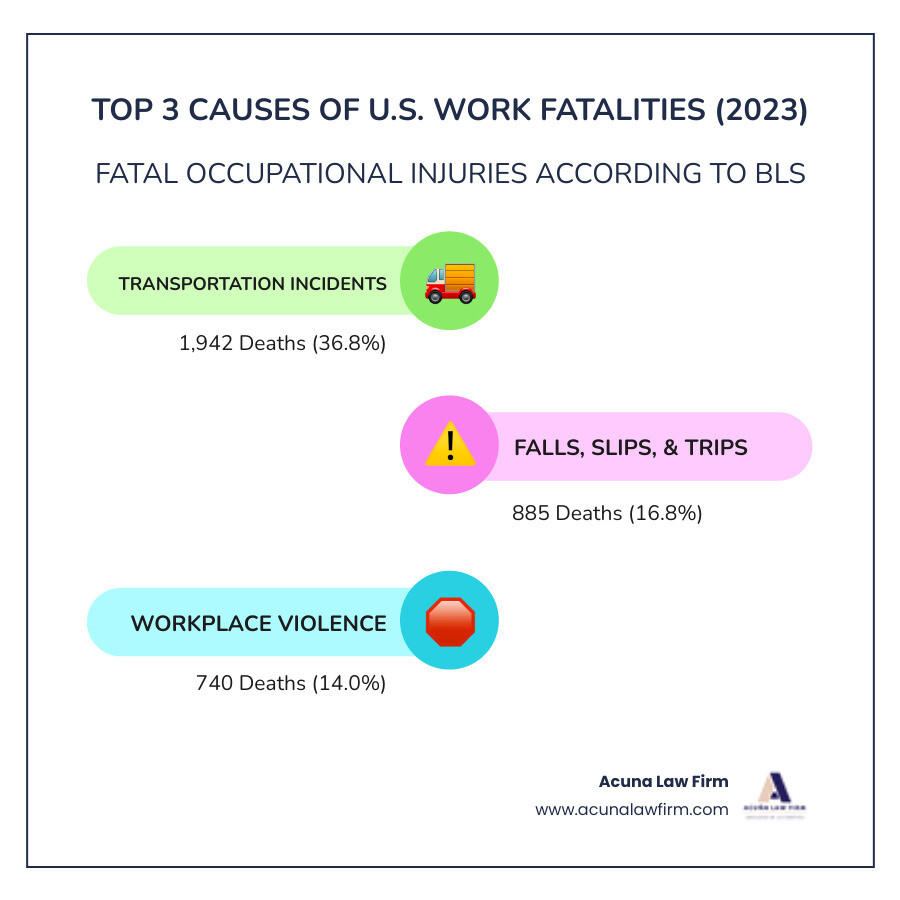
Transportation incidents remain the deadliest hazard, claiming 1,942 lives in 2023 (36.8% of all fatalities). This includes not only truck drivers but also workers struck by vehicles, forklift accidents, and other on-the-job collisions.
Falls, slips, and trips took 885 lives in 2023. In construction, falls accounted for 39.2% of fatalities (421 deaths). Most of these fatal falls (64.4%) occurred from modest heights of 6 to 30 feet, with 109 deaths involving portable ladders and stairs, highlighting the danger of everyday equipment.
Violence in the workplace claimed 740 lives in 2023, with homicides alone accounting for 458 deaths. Homicides are a significant issue beyond security jobs, accounting for 30% of retail trade fatalities and 33.7% in protective services. Workplace suicides also contribute to this tragic statistic.
Contact with objects and equipment led to 779 fatal injuries, while exposure to harmful substances or environments resulted in 820 fatalities. These categories include being struck by objects, caught in machinery, or exposed to toxins or extreme temperatures.
America’s Most Dangerous Industries and Jobs
Some sectors face dramatically higher dangers than others.
Construction leads all industries with 1,075 deaths in 2023. The combination of heights, heavy machinery, and changing environments creates a perfect storm of risk. For families affected, understanding rights regarding Accidentes de Construcción is a crucial step.
Transportation and Warehousing recorded 930 fatalities in 2023. Despite an 11.7% decrease, transportation incidents still caused 71.7% of these deaths.
Administrative and Support Services, including waste management and landscaping, saw 484 fatalities.
Looking at specific jobs, the risks are stark. Logging workers have the highest fatality rate (82.2 deaths per 100,000 workers), followed by fishing and hunting workers (75.2). Transportation and material moving occupations had the most total fatalities (1,495), with heavy and tractor-trailer truck drivers making up a large portion.
Contributing Factors: Violence, Weather, and Substance Abuse
Several underlying factors amplify workplace dangers.
Workplace violence extends beyond assault, with 458 homicides in 2023 affecting retail and service workers as well as security personnel. Workplace suicides add another tragic layer, highlighting the need for mental health support.
Weather was a factor in 100 fatalities in 2023. Extreme conditions pose serious risks to outdoor workers in construction, agriculture, and utilities.
Substance abuse, particularly involving opioids, is a growing safety issue. In 2023, opioids were the primary cause in 162 fatalities and a contributing factor in 144 more, underscoring the need for comprehensive prevention and support programs.
A Global and Economic Perspective on Workplace Deaths
Every 99 minutes, a worker dies on the job in the United States. This challenge crosses every border, and understanding how America compares globally—and the true cost of these tragedies—provides a fuller picture of workplace safety.
The U.S. fatal work injury rate was 3.5 per 100,000 full-time workers in 2023, slightly below the global average of around 4.0. However, some countries report far lower rates (Panama: 0.2; El Salvador: 0.1), while others are much higher (Cuba: 25; Burundi: 13.8). These differences reflect varying levels of safety enforcement, economic structures, and investment in worker protection.
The WHO/ILO Joint Estimates of the Work-related Burden of Disease and Injury reveal that nearly 2 million people die from work-related causes globally each year. Surprisingly, most deaths are from diseases developed over time, not sudden accidents.
Long working hours (over 50 per week) are a major global factor, contributing to over 745,000 deaths in 2016 from related heart disease and stroke. Exposure to harmful substances like particulate matter, gases, and fumes killed over 450,000 people globally in 2016, primarily from chronic obstructive pulmonary disease (COPD).
Direct occupational injuries caused over 363,000 deaths worldwide in 2016. These statistics show that workplace hazards include slow, invisible dangers that accumulate over years, not just immediate physical threats.
The Economic Toll of Work Fatalities
Behind every work fatality statistic is a family facing potential financial devastation. The economic impact ripples far beyond the workplace.
Direct costs include emergency care, funeral expenses, and workers’ compensation, which can cause insurance premiums to skyrocket. However, these are just the tip of the iceberg.
Indirect costs are even greater, including lost productivity, investigation downtime, recruitment and training for replacements, and decreased team morale. Legal fees and regulatory fines can mount, and a company’s reputation can take years to rebuild.
For families, the financial impact is crushing, with lost income and mounting bills. The emotional toll compounds this stress, affecting generations. The total economic toll of work fatalities is staggering, making prevention not just a moral imperative but an economic one.
For families navigating this aftermath, understanding your rights regarding Lesiones Personales and compensation can provide stability. While no money can replace a loved one, holding negligent parties accountable can help prevent future tragedies and provide families with needed resources.
A Proactive Approach to Prevention and Safety
Every work fatality is preventable. Workplaces with excellent safety records share a genuine commitment to protecting their people, backed by concrete actions.

Employer Responsibility
The Occupational Safety and Health (OSH) Act legally requires employers to provide a safe workplace, protecting workers from recognized hazards. This involves:
- Establishing and following OSHA standards. These are mandatory requirements, not suggestions.
- Providing essential training. Training must be ongoing, adapting to new jobs, equipment, and hazards. It must also be accessible, including being offered in workers’ primary languages.
- Maintaining safe working conditions through regular inspections and proper equipment maintenance.
- Conducting thorough risk assessments to proactively identify and control hazards, from machinery and chemicals to workplace violence.
Key Strategies to Reduce Work Fatalities
Preventing work fatalities requires a comprehensive approach targeting specific hazards:
- Comprehensive safety programs: These should be living documents that are regularly reviewed, updated, and clearly communicated to all employees.
- Fall protection: With falls causing nearly 40% of construction deaths, often from modest heights, fall protection is critical. This includes guardrails, safety nets, personal fall arrest systems, and strict protocols for ladder use.
- Vehicle safety: As transportation incidents are the leading killer, employers must implement defensive driving training, vehicle maintenance schedules, fatigue management, and zero-tolerance policies for distracted driving.
- Violence prevention: High-risk industries need physical security measures, de-escalation training, and clear procedures for reporting threats.
- Equipment maintenance and guarding: Regular inspections, proper machine guarding, and strict lockout/tagout procedures prevent contact-related fatalities.
- Hazard communication: Workers must be trained on the dangerous substances they handle, using labels and safety data sheets to prevent exposure-related deaths.
- Substance abuse programs: With opioids linked to hundreds of deaths, employers need policies that support workers struggling with addiction while maintaining a safe work environment.
- Strong safety culture: This means encouraging workers to report hazards without fear of retaliation and involving them in safety planning.
- Emergency preparedness: Plans for extreme weather must be developed and practiced to protect workers from environmental hazards.
- Personal protective equipment (PPE): Employers must provide and ensure the correct use of PPE like hard hats, safety glasses, and respirators.
When employers fail in these duties, families have legal rights. If negligence has affected you, understanding your options for Lesiones Personales compensation is a vital step toward justice.
Frequently Asked Questions about Work Fatalities
Work fatalities raise difficult questions. Here are straightforward answers to common concerns.
What is the most dangerous job in the United States?
By fatality rate, logging workers have the most dangerous job, with 82.2 deaths per 100,000 full-time workers. They are followed by fishing and hunting workers (75.2 per 100,000), roofers, and aircraft pilots. The risk comes from dangerous equipment, remote locations, unpredictable weather, and physically demanding work.
What should I do if I believe my workplace is unsafe?
Your safety is the priority. If you see a hazard, take action.
First, report the hazard to your supervisor or employer, who is legally required to address it. Document your report.
If the problem isn’t fixed or you feel unsafe reporting it internally, contact OSHA directly at 1-800-321-OSHA. You can file a confidential complaint.
Crucially, the OSH Act protects you from retaliation. Your employer cannot legally punish you for reporting safety concerns. If they do, you can report the retaliation as a separate violation. You have a protected right to a safe work environment.
What is legally considered a work-related fatality?
A work-related fatality is a death resulting from an injury sustained during work activities. This includes deaths at the workplace during work hours, off-site while performing job duties, or from an illness directly caused by a work injury or acute exposure. For example, a death from complications weeks after a chemical exposure at work would be counted.
However, deaths from long-term occupational diseases are typically tracked separately. If a loved one died due to circumstances arising from their employment, especially due to negligence, it may be considered a wrongful death—or muerte injusta. Families in this situation have legal rights to seek justice and compensation. Learn more about Muerte Injusta and your family’s legal options.
Conclusion: Upholding the Right to a Safe Workplace
Behind each of the 5,283 work fatalities in 2023 is a family forever changed. These aren’t just statistics; they are preventable tragedies that shatter families and communities.
The data is clear: transportation incidents, construction accidents, and high-risk jobs are leading causes of death. Knowing this is not enough; what matters is what we do with this knowledge.
Creating safer workplaces is a shared responsibility. Employers must invest in equipment, training, and a positive safety culture. Workers must follow protocols and report dangers. When negligence leads to a workplace death, families face crushing grief and financial pressure from lost income and mounting bills.
Understanding your legal rights matters. A wrongful death claim is about accountability and ensuring the responsible company takes safety seriously to prevent future tragedies. It is also about securing the financial future your loved one worked to provide.
For families dealing with accidentes de construcción, transportation accidents, or any fatal workplace incident, you don’t have to face this alone. At Acuna Law Firm, we understand the weight you’re carrying. We’ve helped countless families seek justice and recover millions in compensation. We offer bilingual support, free consultations, and a genuine commitment to helping you through this difficult time.
Your loved one deserved a safe workplace. Your family deserves answers and support. If you’ve lost someone to a workplace tragedy, reach out. Let us help you understand your rights and pursue the justice your family deserves.