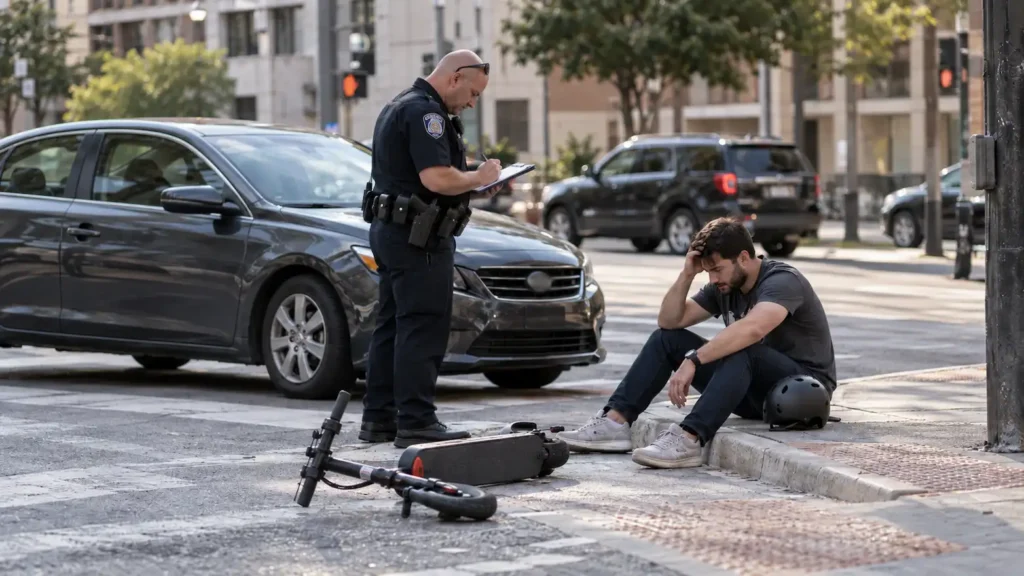
A scooter accident attorney starts at the point where the collision took place: looking at the physical evidence of what happened on that road, at that intersection, and at that moment.
Unlike most car accident claims, riders in Oklahoma who have been injured as a result of careless driving face an evidence problem since the scooter takes on the impact at a different height and angle compared to a passenger vehicle, meaning the pattern of damage tells a different story and that story has to be recorded before the road is resurfaced, the traffic camera footage is erased, and the witness who saw the lights forgets the order in which the events took place.
A scooter accident attorney who approaches the negotiation having a full set of evidence responds to each of those points with specific facts from the documentation rather than relying solely on the rider’s statement.
At Acuña Law Firm we represent scooter riders who have been injured in vehicle collisions throughout Oklahoma, including those cases in which the injuries were serious and the insurance company’s initial offer did not reflect that.
Why Scooter Accident Claims Involve a Specific Liability Framework
The right-of-way protections granted by Oklahoma’s traffic laws to scooter riders are identical to those given to the operators of other motor vehicles on public roads, and if a driver breaches these protections he or she must accept the same level of liability for any resulting harm. When a scooter accident attorney is looking at a claim, they look at the particular traffic violation which caused the collision since that violation forms the basis of the liability argument.
Left-turn accidents (those in which a driver goes into oncoming traffic and hits a scooter that they did not see or miscalculated the speed of) are the most frequent type of incident leading to serious scooter injuries. The driver’s failure to give way is a clear and specific traffic offence, and in Oklahoma this breach constitutes direct evidence of negligence for the purposes of a civil claim.
Separate liability assessments must be carried out for rear-end collisions, instances where a driver runs a red light or a stop sign at an intersection, and accidents that occur when a driver opens a door in an urban area, with the scooter accident attorney comparing these analyses to the physical evidence collected at the scene.
The modified comparative negligence rule in Oklahoma enables the insurer of the driver at fault to decrease the amount it pays out by attributing blame to the rider. Any claims that the rider was speeding, weaving, was not visible, or was riding in an unsafe manner are all the kinds of points the defence uses in order to shift the calculation of the damages.
A scooter accident attorney and who has the traffic camera footage, the rider’s GPS track, the narrative from the police report, and the witnesses’ statements put together into a clear record of liability finds it much harder to maintain those arguments.
The Digital Evidence That Makes a Scooter Accident Claim Provable
The digital aspect of evidence in scooter accident claims was nonexistent in vehicle collision cases a decade ago, and a scooter accident attorney will be able to establish a factual record that the insurer cannot merely dismiss.
Traffic cameras situated at intersections are managed by municipal authorities and by private companies at the entrances to car parks, shopping centres, and other commercial establishments. The majority of these systems store the footage on rolling loops for periods ranging from seventy-two hours to thirty days.
But if such a request is not made, the recording which showed the driver running the red light has disappeared by the time the attorney asks for it.
The ride data produced by scooters that have an app connected to them or those equipped with built-in GPS systems records the rider’s speed, the route taken, and their position within the lane at the moment of the collision. This data goes against the insurance company’s claims regarding speed by providing objective, timestamped information directly from the device.
Our Oklahoma City car accident attorney page at Acuña Law Firm explains how we approach collision cases involving vulnerable road users and what a complete investigation looks like from the first legal hold notice to the final demand package.
Scooter Accident Medical Documentation and What It Has to Capture
The medical records relating to the scooter accident form the basis of the claim for damages and must start on the day of the collision, not the day after. If a rider leaves the scene of the accident without getting medical attention, this creates a gap which the insurance company can take advantage of at all stages of the claim by asserting that the injuries were not serious enough to demand immediate treatment and that the symptoms the rider gives later are either exaggerated or not connected with the accident.
The clinical baseline is established by the emergency department record on the day of the accident; this record includes the initial diagnosis, the diagnostic imaging carried out, and the physician’s immediate assessment of how the injury occurred. All subsequent visits, any referrals to specialists, the physical therapy records, and the later functional assessments extend the picture of the damages from that baseline in such a way that the insurance company cannot reframe them as being unrelated to the accident.
The medical records following a scooter accident have to clearly record the injuries that result from the rider’s experience in the collision, such as road rash that extends below the skin’s surface and causes scarring or changes to the skin’s texture, injuries to the wrists, elbows, and shoulders caused by the impact when the rider lands, knee and hip injuries caused by the transfer of momentum as the scooter comes to a stop and the rider does not, and head injuries even if a helmet was worn.
Among the most important injuries from a legal point of view in a case involving a scooter accident are the neurological symptoms of a concussion, including cognitive fog, sensitivity to light and sound, and disrupted sleep, since these affect the rider’s ability to work and carry out daily activities without showing up in a photograph.
Scooter Accident Case Evaluation and the Coverage Picture
A scooter accident case evaluation involves more than just examining the strength of the evidence showing liability; it looks at the entire range of coverage that is available to pay for the rider’s damages, since the responsible driver’s liability policy is not the only source from which compensation can be obtained and is often not sufficient on its own to cover serious injuries.
Oklahoma mandates that people who operate motor vehicles must have a minimum level of liability coverage, but this minimum amount is generally much less than the cost of a serious scooter injury when you take into account medical bills and lost income.
If the at-fault driver’s liability limit is not enough, then the rider can turn to their own uninsured or underinsured motorist coverage, this is the next option for recovery and it is not something that is offered at the rider’s own initiative. A scooter accident attorney will locate this coverage, file the official claim under the rider’s own insurance policy, and if needed, take the case through the rider’s insurance company.
Medical payments coverage, which is included in some Oklahoma automobile insurance policies, will pay for part of the costs of emergency and immediate treatment without it being necessary to establish fault, thus giving the rider financial access to care while the liability claim is being resolved. Personal injury protection coverage works in a similar way if it is available.
When a case involving a scooter accident is being evaluated, all of these possible sources of coverage are identified before any settlement proposal is looked at, since taking an early offer from the other driver’s insurance company without first identifying other possible sources of coverage could result in a settlement that uses up one policy while failing to take advantage of the others.
What the Insurer’s Offer Reflects and What It Does Not
The first offer a scooter accident rider receives from the responsible driver’s insurer is calibrated to the evidentiary record available when the offer is made, which is almost always incomplete. It reflects the emergency room bill, the visible physical injury from the photographs, and an assumption that the rider will recover fully.
It does not reflect the specialist evaluations not yet completed, the neuropsychological testing that would document the cognitive consequences of a head injury, the functional capacity evaluation that would quantify what the rider can and cannot do as a result of the orthopedic injuries, or the forensic economic projection of the income they will not earn during the extended recovery or permanently.
A scooter accident attorney who understands the gap between the early offer and the fully documented claim value does not begin negotiation when the insurer extends that first number. The negotiation begins when the medical record is complete, the functional consequences are evaluated, the future damages are projected, and the liability file is assembled with the digital evidence, the witness accounts, and the expert analysis that makes the rider’s version of the collision the version the record supports.
The coverage picture also affects what the demand letter addresses. When the responsible driver’s policy limits are insufficient, the demand has to simultaneously establish what the rider’s UIM coverage supports and how the two sources are structured to maximize what the rider actually receives. A scooter accident attorney who manages that multi-insurer coordination produces a result that a rider negotiating alone is rarely positioned to reach.
Oklahoma’s Statute of Limitations and Why Evidence Runs Out First
Oklahoma’s personal injury statute of limitations is two years from the date of injury under Title 12, Section 95 of the Oklahoma Statutes. That deadline applies to scooter accident claims the same way it applies to any vehicle collision claim, and it does not extend because the rider was in active treatment, because the insurer’s negotiations were ongoing, or because the rider was unaware of the timeline.
The evidence that makes a scooter accident case provable deteriorates on a timeline far shorter than two years. Traffic camera footage overwrites. Event data recorder information can be lost after vehicle repair or resale. The scooter itself, if it carried GPS or ride data, may be repaired, sold, or discarded before that data is extracted. Witnesses recall the collision in less detail with each passing week.
When the collision involved a government vehicle or occurred in a location controlled by a government entity, the Oklahoma Governmental Tort Claims Act requires a written notice of claim to be filed within one year of the injury before any lawsuit can proceed. That one-year requirement operates independently of the general two-year period, and missing it bars the claim regardless of how thoroughly the liability evidence is documented.
Before Any Offer Is Accepted or Any Statement Is Given
The insurer’s adjuster who calls the scooter rider in the days immediately following the collision is not calling to help. The adjuster is calling to gather information that can be used to evaluate the claim in the insurer’s favor, to establish the rider’s account before the full injury picture is clear, and in some cases to present an offer that closes the claim before a scooter accident attorney has had the opportunity to build the complete file.
A recorded statement given to the responsible driver’s insurer before legal representation is in place is one of the most consistently consequential mistakes riders make in the early days after an accident. The statement locks in the rider’s account of the collision and the injuries at the moment when both are least fully understood. Inconsistencies between that early statement and the later medical documentation become credibility arguments the insurer uses throughout the claim.
Explore the legal options for your scooter accident claim before accepting any offer or giving any recorded statement. Reach out to Acuña Law Firm for a direct and confidential case evaluation that covers the liability evidence, the coverage picture, and the deadline status before the insurer’s timeline becomes the only timeline that matters.
FAQ
What does a scooter accident attorney do differently than a general personal injury attorney?
A scooter accident attorney understands the specific liability dynamics that arise when a rider on a smaller vehicle is struck by a motor vehicle, including how the physical evidence from a scooter collision differs from a car-to-car impact, how digital evidence from app-connected scooters and traffic cameras applies to the claim, and how insurance companies characterize rider fault in these cases.
What is the most time-sensitive scooter accident claim evidence?
Traffic camera footage is the most time-sensitive. Municipal and private cameras typically record on rolling loops of seventy-two hours to thirty days, and without a formal preservation demand, that footage is overwritten in the ordinary course of operations. GPS or ride data from the scooter, event data recorder information from the responsible vehicle, and witness contact information from the accident scene are all subject to deterioration or loss within days to weeks of the collision.
How does a scooter accident case evaluation assess available coverage?
The case evaluation identifies every potential source of recovery available to the injured rider. The responsible driver’s liability policy is the starting point. When that coverage is insufficient, the rider’s own uninsured or underinsured motorist coverage provides an additional source. Medical payments coverage or personal injury protection, if available under the rider’s own policy, can cover immediate treatment costs independently of the fault determination. The evaluation structures all of those sources before any settlement offer is accepted.
What scooter accident medical documentation is most important?
The emergency department record from the day of the collision establishes the clinical baseline. All follow-up appointments, specialist referrals, diagnostic imaging results, physical therapy notes, and functional assessments build the damage picture from that baseline forward. Neurological symptoms of a concussion, which affect the rider’s ability to work and function without producing visible findings in photographs, require neuropsychological testing to document objectively.
What is the statute of limitations for a scooter accident claim in Oklahoma?
Oklahoma’s statute of limitations for personal injury claims is two years from the date of injury under Title 12, Section 95. When the collision involved a government vehicle or occurred in a location controlled by a government entity, the Governmental Tort Claims Act requires a written notice of claim within one year of the injury. Missing either deadline eliminates the right to pursue compensation through the courts regardless of the strength of the liability evidence.