
A head on car accident attorney starts where the collision actually happened: at the lane boundary the responsible driver crossed. Head-on crashes produce the highest combined force of any two-vehicle collision because both vehicles’ speeds add together at impact. The injuries that result from that combined force are frequently catastrophic, and the legal and insurance questions that follow are proportionally complex.
Unlike rear-end collisions where the physics generally point liability in one direction, a head-on crash raises an immediate factual question about why the vehicle left its lane. That question has multiple possible answers, each of which produces a different liability argument and a different insurance response. A head on car accident attorney who investigates that question thoroughly, with the physical evidence from the scene before it is cleared, puts the injured person in a fundamentally different position than one who reconstructs the accident from what remains weeks later.
At Acuña Law Firm we represent people injured in head-on collisions throughout Oklahoma, including cases where the responsible driver’s insurance company moved quickly with an initial offer that did not reflect the full scope of the injuries or the long-term consequences.
Why Head-On Crashes Raise Specific Liability Questions
The liability argument in a head on car accident starts with what caused the lane departure. Impairment by alcohol or drugs is one of the most common causes of wrong-way or center-line crossing crashes, and a head on car accident attorney who identifies impairment as a factor pursues the evidence of that impairment through the responding officers’ reports, the toxicology results from any blood draw conducted at the scene or hospital, and any witness accounts of the driver’s behavior before the collision.
Driver distraction, whether from a phone or other in-vehicle activity, produces a similar pattern of gradual lane drift that frequently shows up in the final seconds of dashcam or traffic camera footage before impact. Fatigue produces a comparable signature when a driver’s speed and lane position data are available. Medical events, including seizures or sudden loss of consciousness, raise different liability questions because they may involve the driver’s prior knowledge of a medical condition and a failure to disclose it.
Vehicle defect cases are a distinct category where the lane departure was caused by a mechanical failure rather than driver conduct. A tire blowout from a manufacturing defect, a steering failure from a maintenance issue, or a brake system failure all shift the liability analysis toward product liability or negligent maintenance, and a head on car accident attorney who identifies that possibility early preserves the vehicle as evidence before it is repaired or sold.
The Physical Evidence a Head On Car Accident Attorney Needs First
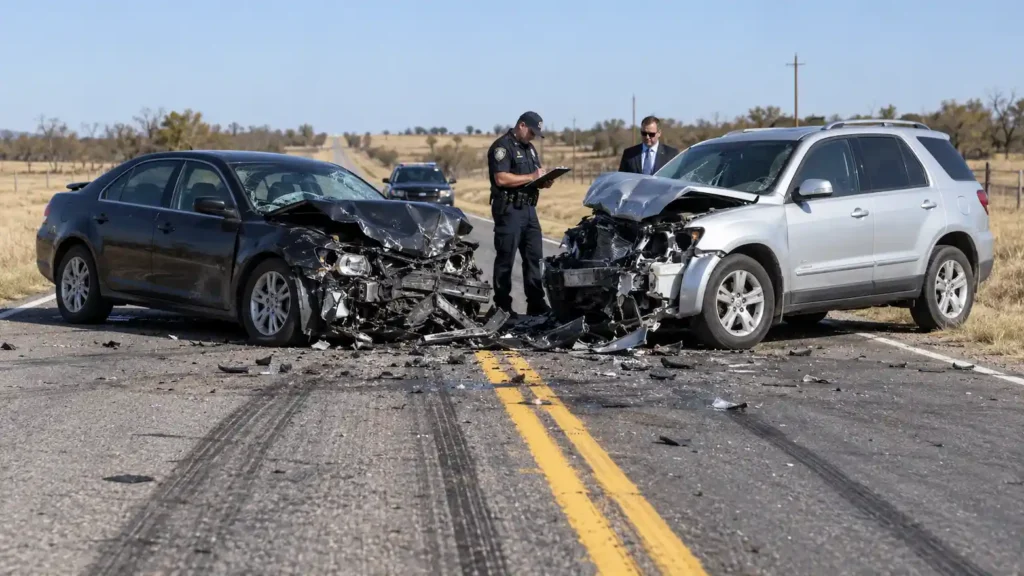
Head-on collision scenes produce physical evidence that disappears quickly. Skid marks, tire gouges in the roadway surface, and debris fields show where each vehicle was at various points before and during the collision. The final resting positions of both vehicles, the point of impact based on fluid and debris patterns, and the damage profiles on each vehicle establish a reconstruction framework that a traffic accident reconstruction expert can work from if that evidence is properly documented before the scene is cleared and the road surface is restored.
The vehicles themselves are the most important physical evidence in a head-on crash. The airbag control module in each vehicle stores the speed, braking, and steering inputs from the seconds immediately before impact. That data has to be extracted by a qualified engineer before the vehicle is moved to a salvage yard, repaired, or transferred to a new owner.
A head on car accident attorney who sends a formal evidence preservation letter to the insurance company and the vehicle’s owner in the first days after the crash establishes legal notice that the vehicle must be preserved. Without that letter, the insurer may authorize repair or salvage on a timeline that destroys the data.
Traffic cameras at intersections and commercial property cameras at businesses along the route frequently capture the approach to the collision, showing the driver’s lane position in the seconds before impact. Those recordings operate on short overwrite cycles, typically between seventy-two hours and thirty days. A head on car accident attorney working the case from the first day can request preservation of that footage before it is gone. Waiting even a few days can make the difference between having video evidence and having no video evidence.
Head On Car Accident Insurance Coverage Issues
Head on car accident insurance coverage issues are more layered than in a typical rear-end or intersection collision because of the severity of the injuries involved and the frequency with which the responsible driver’s policy limits are insufficient to cover what those injuries actually cost.
Oklahoma requires drivers to carry minimum liability coverage, but the minimums are set at levels that were established for less catastrophic collisions. A head-on crash that produces spinal cord injuries, traumatic brain injuries, multiple orthopedic fractures, or extended hospitalization generates medical costs that can exceed those minimums by a substantial margin.
When the responsible driver’s coverage runs out, the injured person’s own uninsured or underinsured motorist coverage becomes the next source of recovery. Our Oklahoma City car accident attorney page at Acuña Law Firm explains how we investigate the complete coverage picture for collision cases and what a thorough demand strategy looks like.
A head on car accident attorney who identifies all available coverage sources before the first demand letter goes out structures the case to address each one. When the responsible driver carried a commercial policy because the vehicle was used for business purposes, the commercial policy limits are typically higher and the coverage analysis is different.
When a third party contributed to the crash, whether a vehicle manufacturer, a road maintenance authority, or an employer whose employee was driving while on duty, additional liability sources become part of the coverage picture.
Medical payments coverage under the injured person’s own policy can pay for emergency and immediate treatment costs without requiring a fault determination, giving the injured person access to care while the liability dispute is being resolved. Personal injury protection operates similarly when available. A head on car accident attorney who catalogs all of these sources before settlement talks begin prevents the situation where the injured person accepts a limit-policy offer without knowing that other coverage still exists.
Head On Car Accident Settlement Strategy
Head on car accident settlement strategy is driven by the gap between what the insurer offers based on the currently documented damages and what the case is actually worth when all future consequences are included. That gap is almost always largest in head-on crashes because of the severity of the injuries and the length of the recovery period.
The insurer’s early offer reflects the emergency room bill, the initial diagnosis, and the assumption that recovery will be complete. It does not reflect the specialist evaluations that have not yet happened, the neuropsychological testing that would document any cognitive consequences of a traumatic brain injury, the orthopedic prognosis for whether a spinal injury will require additional surgery, or the vocational assessment of whether the injured person can return to their prior work.
A head on car accident attorney who understands that the full damages picture will not be clear for months does not let the insurer’s timeline become the negotiation timeline.
Settlement timing in a head on car accident case should be tied to the point of maximum medical improvement, the clinical determination that the injured person has recovered as much as they are going to recover from the specific injuries. Before that point, the full extent of the permanent consequences is not known, and settling before it means settling before knowing what the case is actually worth. Oklahoma’s two-year statute of limitations under Title 12, Section 95 gives the injured person time to reach that point and still pursue a full recovery through either settlement or litigation.
The demand package that a head on car accident attorney prepares for settlement negotiation reflects every documented element of the damages: past medical expenses with supporting bills and records, projected future medical costs with supporting expert opinion, lost wages with employment records and pay history, loss of future earning capacity with forensic economic analysis, and non-economic damages for pain, suffering, and the impact on daily life. A demand that is fully supported by documentation does not leave the insurer room to dispute the numbers without disputing the evidence.
What Oklahoma’s Comparative Fault Rule Means in a Head-On Case
Oklahoma’s modified comparative negligence rule allows the responsible driver’s insurer to reduce the damages paid by attributing partial fault to the injured person. In a head-on collision, the most common comparative fault arguments involve claims that the injured person was speeding, was in the wrong portion of their lane, failed to take evasive action, or was impaired themselves.
A head on car accident attorney anticipates each of those arguments and develops the evidence to address them before they appear in the insurer’s response to the demand letter.
The physical evidence from the scene, the vehicles’ electronic data, the traffic camera footage, and the witness accounts all go toward establishing what each driver actually did in the moments before the collision.
When the evidence is documented thoroughly, the insurer’s ability to sustain a comparative fault argument is substantially reduced. When the injured person is found to be more than fifty percent at fault under Oklahoma’s threshold, they cannot recover at all, which is why anticipating and addressing comparative fault arguments is a central part of a head on car accident attorney’s pre-litigation preparation.
The Head On Car Accident Filing Deadline and Why It Matters More Than It Seems
The head on car accident filing deadline in Oklahoma is governed by the general personal injury statute of limitations at Title 12, Section 95, which gives injured people two years from the date of the crash to file a lawsuit. That deadline does not extend because the injured person was in treatment, because negotiations with the insurer were ongoing, or because the injuries were more serious than initially expected.
When the crash involved a government vehicle or occurred on a government-controlled road where a maintenance defect contributed to the accident, the Oklahoma Governmental Tort Claims Act imposes a one-year deadline to file a written notice of claim before any lawsuit can proceed. Missing that one-year notice deadline bars the claim against the government entirely, regardless of how clear the liability evidence is.
The practical urgency in a head-on crash is not the two-year deadline itself. It is what happens to the evidence during the two years before it. Vehicle data gets lost to repair or salvage. Camera footage overwrites. Witnesses forget details. Skid marks and debris patterns disappear from the road surface. The evidence that makes a head on car accident case provable deteriorates on a timeline measured in days and weeks, not years.
Before the First Call from the Responsible Driver’s Insurer
The adjuster who calls in the days after a head-on collision is calling to document the injured person’s account before the full picture of the injuries and the liability is clear. A recorded statement given to the responsible driver’s insurer before legal representation is in place can establish the injured person’s account at a point when both the injuries and the facts of the collision are least well understood. Inconsistencies between that early account and the later medical and investigative record become arguments the insurer uses throughout the claim.
Explore your legal options with the bilingual team at Acuña Law Firm before giving any recorded statement or accepting any offer. A head on car accident attorney can review the liability evidence, the coverage picture, and the filing deadline for your case before the insurer’s timeline becomes the only timeline that matters.
FAQ
What does a head on car accident attorney investigate first?
A head on car accident attorney prioritizes the evidence that disappears fastest. The vehicles’ electronic data recorders must be preserved before the vehicles are repaired or salvaged. Traffic and commercial camera footage needs a preservation request within the first days.
The accident scene’s physical evidence, skid marks, debris patterns, and point of impact markers, needs to be documented before the road is cleared. Witness contact information needs to be secured before people scatter. The cause of the lane departure, whether impairment, distraction, fatigue, or a vehicle defect, is the central liability question, and the evidence that answers it is mostly time-sensitive.
What are the most common head on car accident insurance coverage issues?
The most common issue is that the responsible driver’s liability coverage is insufficient to cover the full cost of serious injuries. When that happens, the injured person’s own uninsured or underinsured motorist coverage becomes the next source of recovery. Medical payments coverage can cover emergency treatment costs without a fault determination.
When the responsible driver was operating a commercial vehicle or was on duty for an employer, the commercial policy and the employer’s liability coverage are additional sources. A thorough case evaluation identifies all of these before any settlement offer is considered.
What is the head on car accident filing deadline in Oklahoma?
Oklahoma’s personal injury statute of limitations is two years from the date of injury under Title 12, Section 95. When the collision involved a government vehicle or occurred where a government entity’s road maintenance may have contributed, the Governmental Tort Claims Act requires a written notice of claim within one year.
Missing the one-year government notice deadline bars the claim against that entity regardless of the strength of the evidence. Both deadlines are hard cutoffs that do not extend for ongoing treatment or negotiations.
When should head on car accident settlement strategy begin?
Settlement strategy begins immediately after the crash, with the evidence preservation and investigation phase. Actual settlement negotiations should wait until the injured person has reached maximum medical improvement so the full extent of the permanent consequences is known. Settling before that point means settling without knowing the case’s full value. The two-year statute of limitations generally allows enough time to reach maximum medical improvement and still negotiate or litigate from a fully documented position.
Can the injured person’s own conduct reduce their recovery in a head-on crash?
Under Oklahoma’s modified comparative negligence rule, the injured person’s damages can be reduced by the percentage of fault attributed to them. If they are found more than fifty percent at fault, they cannot recover at all. In head-on crashes, the responsible driver’s insurer commonly argues that the injured person was speeding, failed to take evasive action, or was partially at fault for other reasons. A head on car accident attorney builds the evidence record to anticipate and address those arguments before they appear in the insurer’s response.