

Understanding Your Rights After a Truck Accident
Lawyers that sue trucking companies are specialized personal injury attorneys who handle complex litigation against commercial motor carriers and their insurers. These attorneys must understand federal trucking regulations, accident reconstruction, and corporate liability to successfully hold negligent trucking companies accountable for serious injuries and wrongful death.
What You Need to Know:
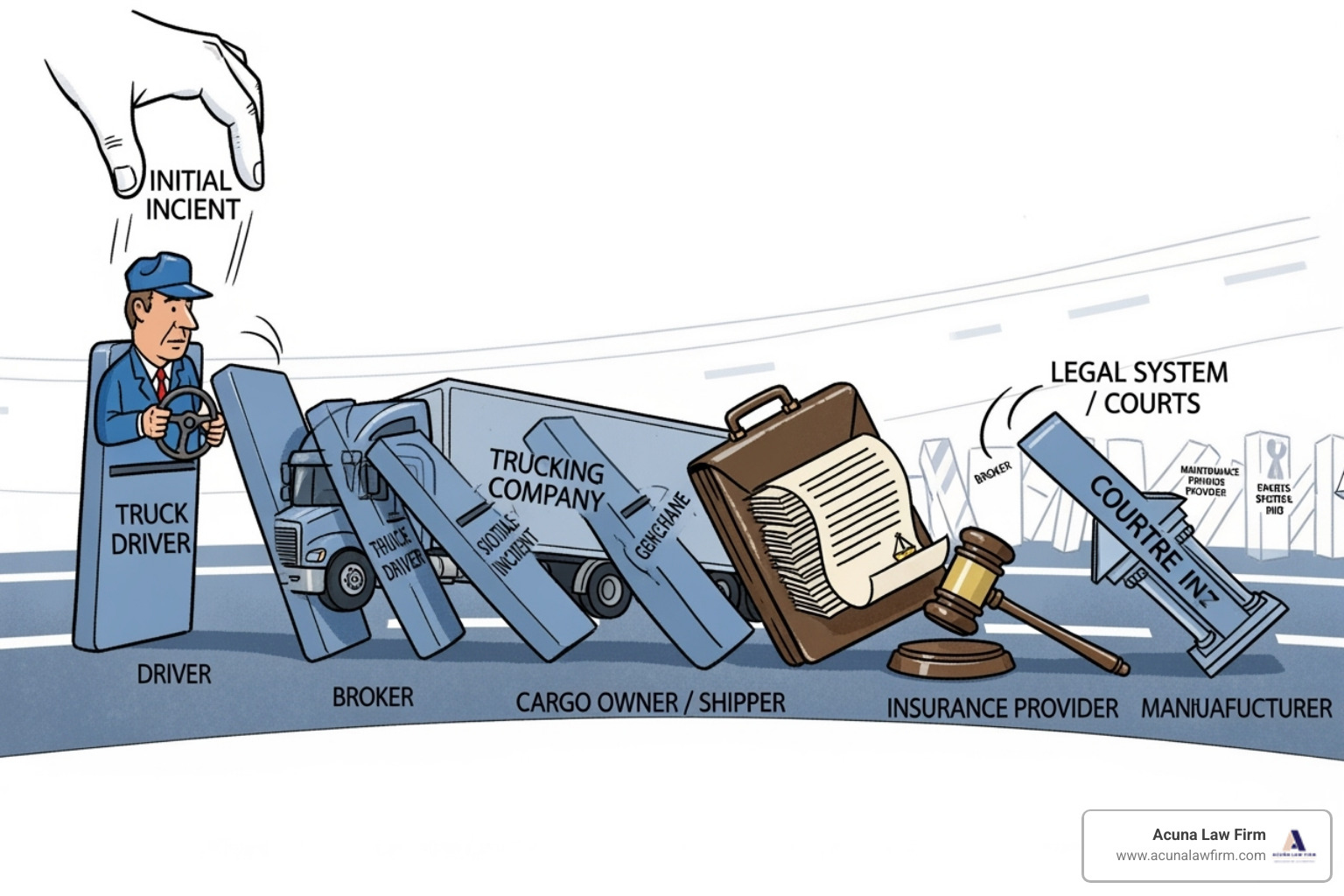
- Who They Sue: Not just the driver—trucking companies, maintenance providers, cargo loaders, manufacturers, and freight brokers
- Why Companies Are Liable: Through vicarious liability (respondeat superior), negligent hiring, poor maintenance, and safety violations
- Key Evidence: Black box data, driver logs, maintenance records, and Federal Motor Carrier Safety Administration (FMCSA) compliance documents
- Types of Damages: Medical bills, lost wages, pain and suffering, and sometimes punitive damages
- Time Limits: Statutes of limitations vary by state (typically 2 years for personal injury)
The commercial trucking industry is massive, with 40 million trucks moving over 72% of U.S. freight annually. With this volume comes risk. The National Safety Council reports that in a single year, over 5,000 trucks were involved in fatal crashes.
When a tractor-trailer collides with a passenger vehicle, the results are often catastrophic. Unlike typical car accidents, these cases involve trucking companies with layers of legal protection, well-funded insurance teams, and sophisticated strategies to minimize their liability. That’s why you need more than just any personal injury lawyer. You need an attorney who understands the trucking industry and has the resources to take on billion-dollar corporations.
Why You Can Sue More Than Just the Driver
After a truck accident, many people assume the driver is the only one responsible. However, the trucking company itself can often be held accountable, along with other parties you might not have considered. Experienced lawyers that sue trucking companies understand these cases involve multiple layers of responsibility.
Trucking companies have a legal duty of care to ensure their drivers are qualified, trained, well-rested, and operating safe vehicles. When they fail, they can be sued directly. Additionally, a legal principle called vicarious liability (or respondeat superior) means an employer is legally responsible for an employee’s actions while on the job.
This is crucial for your case. Suing the company provides access to their substantial insurance policies, which are necessary to cover the high costs of life-changing injuries, medical bills, and lost income.
Common Reasons for Trucking Company Liability
Beyond being responsible for their drivers, companies are directly liable for their own failures. Common examples of company negligence include:
- Negligent Hiring: Hiring drivers with a history of unsafe driving, DUIs, or suspended licenses.
- Poor Driver Training: Cutting corners on training required to operate an 80,000-pound commercial truck.
- Inadequate Supervision: Pushing drivers to meet unsafe deadlines or ignoring signs of fatigue.
- Negligent Retention: Keeping a driver employed despite a clear pattern of violations or unsafe behavior.
- Failure to Maintain Vehicles: Neglecting critical maintenance on brakes, tires, steering, and other systems.
- Ignoring Driver Violations: Turning a blind eye to speeding, distracted driving, or other reckless behavior.
- Hours-of-Service (HOS) Violations: Pressuring drivers to falsify logs or drive beyond federal limits, leading to fatigue.
- Overloading and Improper Cargo Securement: Loading trucks beyond legal weight limits or failing to secure cargo, which can cause rollovers or lost loads.
Each of these failures is a breach of the company’s duty of care. Our team has extensive experience with Personal Injury cases and knows how to prove company negligence.
The Impact of Federal and State Regulations
The trucking industry is heavily regulated by the Federal Motor Carrier Safety Administration (FMCSA) to prevent accidents. For lawyers that sue trucking companies, these regulations are invaluable tools. Proving a company or driver violated a safety rule is powerful evidence of negligence.
The FMCSA regulates driver qualifications, drug and alcohol testing, Hours-of-Service limits, Electronic Logging Devices (ELDs), vehicle maintenance requirements, and cargo securement. The agency also tracks every company’s safety record through the Compliance, Safety, Accountability (CSA) scoring system, which can reveal a pattern of negligence.
When a violation of these federal or state regulations contributes to your accident, it strengthens your case significantly. A driver who fell asleep after exceeding their hours isn’t just an accident—it’s a preventable tragedy caused by breaking the law.
Critical Actions to Take Immediately After a Truck Accident
The moments after a truck accident are chaotic, but what you do next can make or break your ability to get fair compensation. As lawyers that sue trucking companies, we know how crucial these initial steps are.
First and foremost, your safety and health come first. Adrenaline can mask serious injuries like whiplash or internal bleeding, so get medical attention.
- Call 911 Immediately: You need emergency medical help and law enforcement to create an official police report. Never let a driver talk you out of it.
- Do Not Admit Fault: Even a simple “I’m sorry” can be twisted by insurance companies to blame you. Stick to the facts when speaking to anyone.
- Exchange Information: Get the driver’s name, license, and insurance details. Crucially, also get the trucking company’s name, phone number, and USDOT number printed on the truck. This unique identifier is key to investigating the company’s safety history.
- Document Everything: Use your smartphone to take photos and videos of the entire scene. Capture vehicle damage, license plates, the USDOT number, skid marks, road conditions, and any visible injuries. This freezes the scene in time.
- Talk to Witnesses: Get the names and phone numbers of anyone who saw the crash. Their unbiased testimony can be invaluable.
- See a Doctor ASAP: Even if you feel fine, see a doctor within 24 hours. This creates an official medical record linking your injuries directly to the accident. If you wait, the insurance company will argue your injuries came from something else.

Why is this so important? Trucking companies dispatch their own response teams immediately to gather evidence to protect their interests. They are working to minimize their liability from the very beginning.
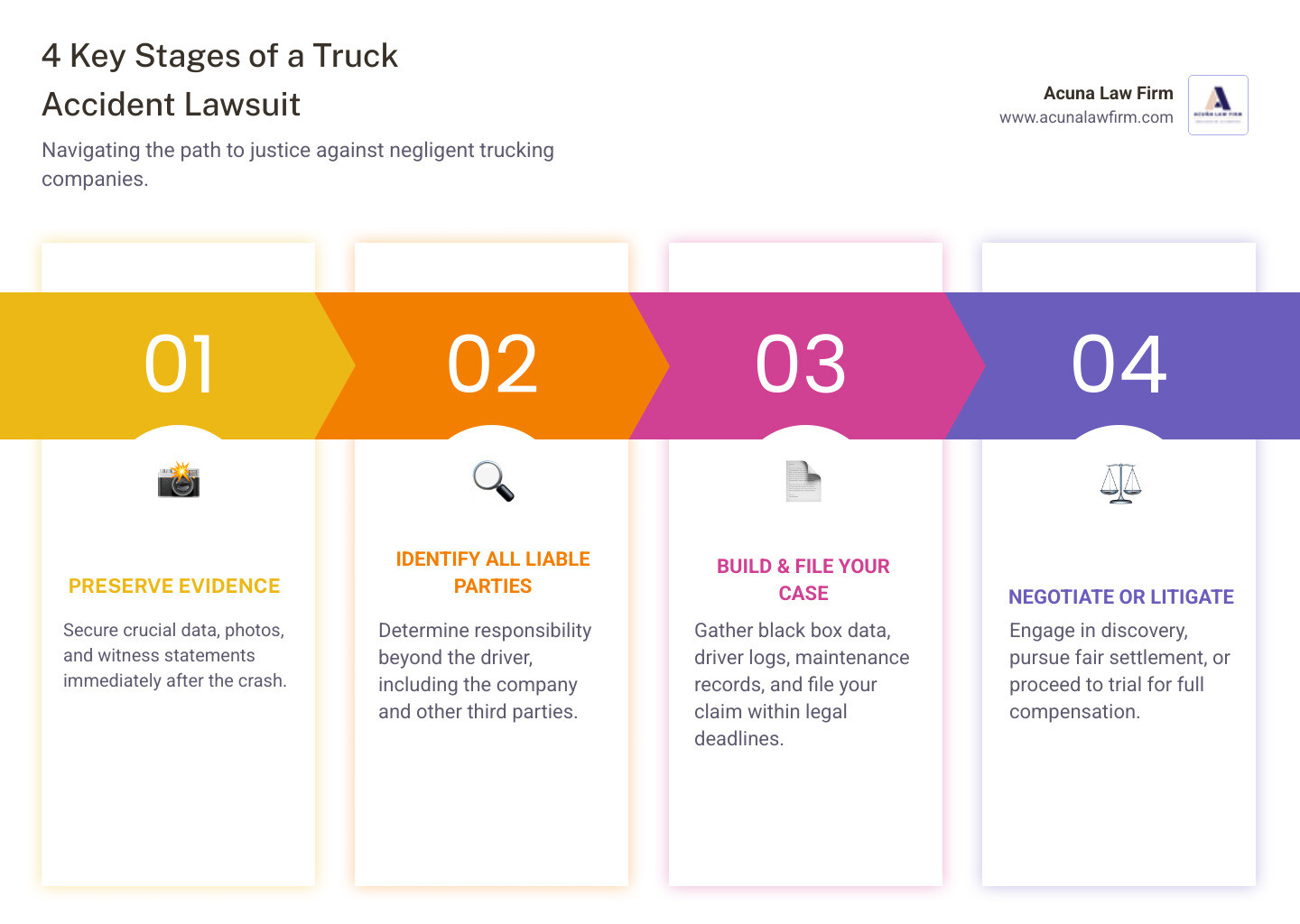
You need someone fighting just as hard for you. The sooner you contact an attorney, the sooner they can send a legal notice to preserve critical evidence like black box data and driver logs before they are destroyed. The actions you take in these first hours protect your future and your right to the compensation you deserve.
How Lawyers That Sue Trucking Companies Build a Winning Case
When you’re up against a trucking company, you’re facing a corporate giant with a team of lawyers and insurance adjusters whose job is to pay you as little as possible. This isn’t a typical car accident case; it requires specialized knowledge and resources.
Lawyers that sue trucking companies build a winning case by taking immediate and strategic action. One of the first steps is sending a spoliation letter, a formal legal demand that requires the trucking company to preserve all evidence related to your accident. This prevents them from destroying or “losing” crucial items like driver logs, maintenance records, and black box data.
We work with accident reconstruction experts to analyze the evidence and recreate exactly what happened. We know how to counter the delay tactics and lowball offers from large insurance companies. Our job is to level the playing field and build a case so strong that they have no choice but to take you seriously.
The Crucial Evidence Your Lawyer Will Secure
Building a winning case requires gathering and analyzing specific evidence unique to the trucking industry. We know what to look for:
- The Truck’s Black Box (ECU/EDR): This device records critical data like speed, braking, and steering, providing objective proof of the driver’s actions.
- Driver’s Electronic Logs (ELDs): These federally mandated logs show whether the driver violated Hours-of-Service rules and was driving while fatigued.
- Driver’s Qualification File: This file contains the driver’s history, including past violations, training records, and medical certifications, which can prove negligent hiring.
- Drug and Alcohol Test Results: Mandatory testing after serious accidents can provide clear evidence of impairment.
- Company Maintenance and Inspection Records: These documents can reveal if the company cut corners on safety by failing to repair faulty brakes, tires, or other defects.
- Dispatch Records and Communications: These can show if the company was pressuring the driver to speed or violate safety rules.
- Police Reports and Witness Statements: The official report and third-party accounts help establish the facts of the crash.
- Dash Camera Footage: Many trucks have cameras that provide undeniable visual evidence of what happened.
Gathering this evidence requires a dedicated legal team. You can learn more about our experienced legal team and how we fight for our clients.
What to Consider When Choosing Lawyers That Sue Trucking Companies
Not all personal injury lawyers are equipped to handle complex trucking cases. Here’s what to look for:
- Experience with Trucking Litigation: Your lawyer should have a deep understanding of federal trucking regulations and a history of handling these specific cases.
- Track Record of Success: Ask about their past results in trucking cases. A history of successful settlements and verdicts is a strong indicator of competence.
- Resources to Fight Large Corporations: Your firm must have the financial resources to hire experts and take on well-funded corporate legal teams.
- Contingency Fee Basis: Reputable firms work on a contingency fee, meaning you pay nothing unless they win your case.
- Clear Communication: You need a lawyer who keeps you informed and answers your questions in plain language.
- Positive Client Reviews: Testimonials show what it’s like to work with the firm and whether they treat clients with respect.
Choosing the right attorney is a critical decision. Meet attorney Mariano Acuña to see the dedication we bring to every case.
The Path to Compensation: Damages, Settlements, and Challenges
Getting fair compensation after a truck accident is a battle. Trucking companies and their insurers aim to pay as little as possible, often making lowball settlement offers quickly, hoping you’ll accept before you know the true value of your claim. Never accept an offer or give a recorded statement without speaking to an attorney.
If negotiations fail, the litigation process begins with filing a lawsuit. This is often followed by the findy phase, where both sides exchange information through written questions, document requests, and depositions (sworn testimony). This is where we uncover critical evidence of negligence. While many cases settle before trial, we are always prepared to go to court to fight for the compensation you deserve.
Types of Damages You Can Recover
“Damages” is the legal term for the compensation you can recover. We work to ensure every loss is accounted for.
Economic Damages (tangible costs):
- Medical Bills: All past and future costs, from the ambulance ride to long-term rehabilitation.
- Lost Wages: Income lost while recovering.
- Loss of Future Earning Capacity: Compensation if you can no longer work or must take a lower-paying job.
- Property Damage: The cost to repair or replace your vehicle.
Non-Economic Damages (intangible losses):
- Pain and Suffering: Compensation for the physical pain and emotional distress caused by your injuries.
- Emotional Distress: For the psychological impact, such as anxiety, depression, or PTSD.
- Loss of Consortium: For the negative impact on your relationship with your spouse.
- Wrongful Death Damages: For surviving family members, covering funeral costs and the loss of financial and emotional support.
In some states, like New York, you may need to prove a “serious injury” as defined by law, such as in ISC § 5102(d), to pursue certain claims.
When Punitive Damages and Comparative Negligence Apply
Two other concepts can significantly impact your case:
- Punitive Damages: These are not to compensate you, but to punish the defendant for extreme misconduct, such as a company knowingly letting an intoxicated driver on the road or deliberately falsifying safety logs. They are reserved for cases of malice or reckless indifference to human safety and are meant to deter future bad behavior.
- Comparative Negligence: This law applies if you are found partially at fault for the accident. Most states, including Oklahoma, use a modified comparative negligence rule. Your compensation is reduced by your percentage of fault. For example, if your damages are $100,000 but you are found 10% at fault, you would receive $90,000. However, if you are found 51% or more at fault, you recover nothing. Insurance companies will try to shift blame to you, and our job is to fight these tactics.
Frequently Asked Questions about Suing a Trucking Company
After a truck accident, you’re bound to have questions. As lawyers that sue trucking companies, we want to provide clear, honest answers.
What is the statute of limitations for a truck accident lawsuit?
Every state has a statute of limitations, which is a strict deadline for filing a lawsuit. If you miss this deadline, your case will be dismissed, no matter how strong it is. For personal injury claims, this is often two or three years from the accident date. For example, Pennsylvania’s deadline is 2 years under Pa. C.S.A. § 5524. Because evidence can disappear quickly and building a strong case takes time, it is crucial to contact an attorney as soon as possible to protect your rights and confirm your specific deadline.
Can I sue both the truck driver and the trucking company?
Yes, and it is often the best strategy. The driver can be sued for their direct negligence (like speeding or texting), while the trucking company can be sued for its own failures, such as negligent hiring, poor maintenance, or encouraging drivers to violate safety rules. The company can also be held responsible for the driver’s actions through vicarious liability. Suing both parties provides a better opportunity to recover full compensation, as trucking companies carry much larger insurance policies than individual drivers.
How long does a truck accident lawsuit take to settle?
There is no simple answer, as every case is unique. A straightforward case might settle in a few months, while a complex one could take a year or more. The timeline depends on several factors:
- Severity of Injuries: We must wait until we understand the full extent of your long-term medical needs before settling.
- Complexity of Liability: If fault is disputed or multiple parties are involved, the case will take longer.
- Willingness of the Insurer: Some insurance companies negotiate fairly, while others use delay tactics that force the case toward trial.
While we work efficiently, our priority is to secure the maximum compensation you deserve, not to settle quickly for less.
Take the First Step Towards Justice

Being in a truck accident is overwhelming. You’re dealing with physical pain, emotional trauma, and mounting bills, all while facing a trucking company with a legal team dedicated to minimizing your claim. This is not a fight you should face alone.
As lawyers that sue trucking companies, we know their tactics and understand the complex federal regulations that govern the industry. We know how to use black box data, driver logs, and maintenance records to hold corporations accountable when they put profits over safety.
At Acuna Law Firm, we shoulder the legal burden so you can focus on healing. We are committed to our clients and their families, offering bilingual support in both English and Spanish because clear communication is essential. We also work on a contingency fee basis, which means you pay us nothing unless we win your case. No recovery, no fee.
The trucking company’s resources may seem intimidating, but you have rights. You deserve compensation for your injuries, pain, and losses. However, legal deadlines are strict and evidence can disappear. The time to act is now.
If you or a loved one has been injured in a truck or bus accident, we are ready to listen and fight for you. Schedule your free consultation for Truck and Bus Accidents with our team today. Let’s take the first step toward justice—together.