

Personal Injury Rights: 3 Essential Steps to Protect
Protecting Your Personal Injury Rights
When an accident caused by someone else’s carelessness leaves you with medical bills, lost work, and pain, it’s crucial to understand your personal injury rights. Personal injury law, or tort law, is designed to protect you and allow you to seek financial recovery for your losses.
Here’s what your rights mean for you:
- Right to Compensation: If another party’s actions caused your injury, you have the right to seek compensación for medical bills, lost wages, and pain and suffering.
- Right to Accountability: You can hold the at-fault person or company legally responsible for the harm they caused.
- Right to Legal Counsel: You have the right to hire an experienced abogado to guide you through the legal process and fight for your best interests.
This guide will explain how personal injury law works and what steps you can take to protect yourself, seek justice, and recover from an unexpected injury.
Understanding the Foundations of Personal Injury Law

Personal injury law, also known as “tort law,” is a part of civil law. Unlike criminal law, which punishes crimes against society, personal injury law focuses on civil liability. Its goal is to compensate you, the injured person, for your losses and help make you “whole” again by getting you back, as much as money can, to the position you were in before the injury.
The Three Grounds for a Claim
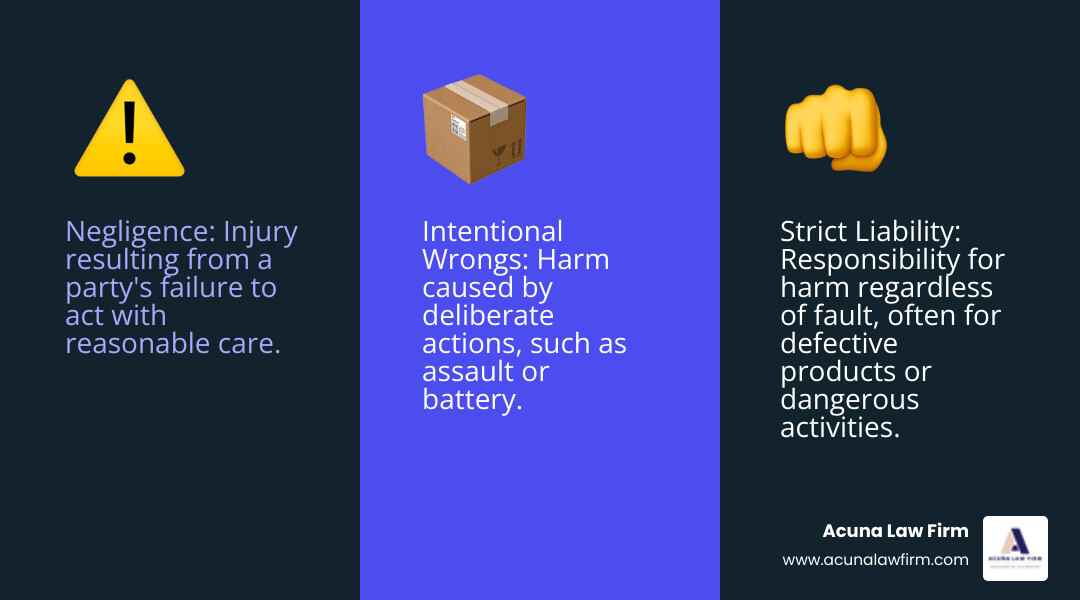
Every personal injury claim falls into one of three categories: negligence, strict liability, or intentional wrongs. Understanding these is key to protecting your personal injury rights.
- Negligence: This is the most common basis for a claim. It occurs when someone fails to use reasonable care, causing harm to another. To prove negligence, four elements are required:
- Duty: The at-fault party had a legal duty to act with care (e.g., a driver’s duty to obey traffic laws).
- Breach: They failed to uphold that duty (e.g., they were texting while driving).
- Causation: Their failure directly caused your injuries.
- Damages: You suffered actual harm or losses (e.g., medical bills, lost income).
- Strict Liability: In some cases, a party can be held liable even if they weren’t careless. This applies in specific situations like:
- Defective products: A manufacturer can be liable if a flawed product causes injury.
- Abnormally dangerous activities: Those engaging in high-risk activities (like using explosives) are held strictly liable for any resulting harm.
- Intentional Wrongs: These claims, also called “intentional torts,” arise when someone deliberately causes harm. Examples include assault, battery, and false imprisonment. These acts can lead to both criminal charges and a civil personal injury claim.
For more on the legal definition of a tort, you can visit What is a tort?.
Common Causes of Personal Injury Claims
Personal injuries can happen in many ways due to another’s negligence. We frequently help clients in Oklahoma City and Tulsa with claims arising from:
- Vehicle Accidents: Collisions caused by distracted, impaired, or reckless driving are a leading cause of injuries. Knowing your personal injury rights after a crash is vital. Learn more on our Accidentes de Autos page.
- Slip and Falls (Accidentes de Caídas): Property owners must keep their premises safe. If hazards like wet floors or poor lighting cause you to fall and get injured, you may have a claim. See our Accidentes de Caídas page for details.
- Medical Malpractice (Negligencia Médica): When medical professionals cause harm through negligence—such as misdiagnosis, surgical errors, or medication mistakes—it constitutes malpractice. Our Negligencia Médica page has more information.
- Defective Products: If a product’s design or manufacturing flaw causes injury, the company can be held liable.
- Dog Bites (Mordedura de Perro): Pet owners are responsible for their animals. If a dog bites you, you have rights to seek compensation. Learn more on our Mordedura de Perro page.
- Workplace or Construction Accidents (Accidentes de Construcción): While workers’ comp often applies, a personal injury claim may be possible if a third party is at fault. Visit our Accidentes de Construcción page for more.
What Compensation Can You Recover?

When you’re hurt because of someone else’s fault, your personal injury rights allow you to recover “damages”—the legal term for money that covers your losses. The goal is to ease the financial and emotional burdens of an injury. Damages are typically divided into three categories.
Economic Damages
These are tangible financial losses that can be easily calculated with bills and pay stubs.
- Medical Expenses: This covers everything from emergency room visits and surgery to physical therapy and future medical care.
- Lost Wages: This includes the salary, bonuses, and other income you lost while unable to work.
- Loss of Earning Capacity: If your injury permanently affects your ability to earn money, this compensates for future lost income.
- Property Damage: This covers the cost to repair or replace your vehicle or other property damaged in the accident.
Non-Economic Damages
These damages compensate for non-financial suffering, which is just as real as any bill.
- Pain and Suffering: Compensation for the physical pain and discomfort you’ve endured.
- Emotional Distress: This covers anxiety, depression, fear, and other psychological impacts of the injury.
- Loss of Enjoyment of Life: If your injury prevents you from enjoying hobbies and daily activities, you can be compensated for this loss.
- Disfigurement or Permanent Disability: Compensation for permanent scars, physical limitations, or lasting impairments, which are often a factor in cases involving a Lesión Cerebral y Espinal.
Punitive Damages
Punitive damages are different; they are not meant to compensate you but to punish the defendant for extremely reckless or malicious behavior. They are rare in Oklahoma and are reserved for cases where the defendant showed a shocking disregard for safety. State law often caps the amount that can be awarded, though exceptions exist for the most egregious cases.
Navigating the Legal Process and Your Personal Injury Rights

Understanding the legal journey is a key part of asserting your personal injury rights. The process involves dealing with insurance companies and deciding whether to settle or go to trial. While most cases settle out of court, preparing for trial is often necessary to secure a fair offer. Our goal is to guide you through every step.
The Statute of Limitations: A Critical Deadline for Your Personal Injury Rights
One of the most important rules is the statute of limitations, a legal deadline for filing a lawsuit. If you miss this deadline, you lose your right to seek compensation forever. In Oklahoma, the deadline for most personal injury claims is two years from the date of the injury. While this may seem like a long time, investigations require time and evidence can disappear, so acting quickly is crucial.
There are rare exceptions that can extend this deadline:
- The Findy Rule: If an injury is not immediately apparent, the two-year clock may not start until the injury is finded or reasonably should have been finded.
- Tolling for Minors: If the injured person is under 18, the clock usually doesn’t start until their 18th birthday.
The Typical Personal Injury Lawsuit Timeline
While every case is unique, most follow a general path:
- Initial Consultation: You meet with an attorney to discuss your case and legal options.
- Investigation and Evidence Gathering: Your legal team collects police reports, medical records, witness statements, and other crucial evidence.
- Filing the Claim: A demand package is sent to the at-fault party’s insurance company, outlining liability and the compensation sought.
- Negotiation and Mediation: Your attorney negotiates with the insurer for a fair settlement. If needed, a neutral mediator may help facilitate an agreement. Most cases are resolved here.
- Filing a Lawsuit: If a fair settlement isn’t reached, a formal lawsuit is filed in court.
- Findy Phase: Both sides formally exchange information through written questions (interrogatories), requests for documents, and sworn testimony (depositions).
- Trial: If the case still hasn’t settled, it proceeds to trial, where a judge or jury makes a final decision.
- Appeal Phase: If either party is unsatisfied with the trial outcome, they may appeal to a higher court.
This process can take anywhere from a few months to several years, depending on the case’s complexity.
The Role of an Attorney in Protecting Your Rights

After an injury, you shouldn’t have to battle insurance companies alone. An experienced personal injury attorney is your most powerful tool for protecting your personal injury rights. We act as your advocate and guide, leveling the playing field against insurers whose goal is to minimize payouts. We handle the legal complexities so you can focus on your recovery.
When to Contact a Lawyer and How They Help
The best time to call a lawyer is as soon as possible after your injury. Evidence like witness memories and surveillance footage can disappear quickly. Early legal guidance helps preserve your claim and prevents costly mistakes.
It is especially important to contact us before giving any recorded statement to an insurance company. Adjusters are trained to ask questions that can undermine your claim. Let us handle all communications with insurers on your behalf.
During a free consultation, we will assess your case, explain your personal injury rights, and outline your options with no obligation. At Acuna Law Firm, we offer bilingual support in Spanish. Ready for answers? You can easily Book Online for a no-obligation review.
How Attorney Fees Work
We work on a contingency fee basis, which means you have no upfront costs. You only pay us if we win your case. Our fee is a percentage of the final settlement or award we obtain for you. This system ensures our goals are aligned with yours—we are motivated to fight for the maximum compensation possible. Litigation costs, such as court filing fees or expert witness expenses, are typically advanced by our firm and reimbursed from the recovery. We explain everything clearly in your consultation so there are no surprises.
Crucial Evidence for Your Claim
A strong claim is built on solid evidence. While we handle the investigation, here are key items to collect if you can:
- Medical records: These document your injuries and link them to the accident.
- Police or incident reports: An official account of what happened.
- Photos and videos: Capture the accident scene, your injuries, and any property damage.
- Witness contact information: Independent accounts can strongly support your case.
- Pay stubs and employment records: These prove lost income.
- All correspondence: Keep emails, letters, and notes from calls related to your case.
Don’t worry if you can’t gather everything; that’s our job. For more information, see the Personal Injury Claims information from the ABA.
Key Legal Problems and State-Specific Rules

Personal injury rights are not uniform across the country; laws vary significantly from state to state. Oklahoma has its own unique rules that can impact your claim, which is why working with a local attorney who understands the state’s legal landscape is so important. These rules can determine whether you receive the compensation you deserve.
Understanding Shared Fault: Contributory vs. Comparative Negligence
One of the biggest differences between states is how they handle situations where the injured person may be partially at fault. Oklahoma follows a modified comparative negligence rule. This means you can still recover damages as long as your share of the fault is 50% or less. Your total compensation will simply be reduced by your percentage of fault. For example, if you are 20% at fault for an accident with $100,000 in damages, you can recover $80,000.
This is much fairer than the harsh contributory negligence rule used in a few states. In those states, if you are found to be even 1% at fault, you are barred from recovering any compensation at all.
Potential Challenges That Affect Your Personal Injury Rights
Even with a strong case, several obstacles can arise on the path to fair compensation.
- Proving liability: It can be challenging to definitively prove that the other party breached their duty of care and caused your injuries, especially with conflicting evidence.
- Dealing with insurance companies: Insurers often use tactics to deny claims or pressure you into accepting a lowball settlement. Their goal is to protect their profits, not you.
- Low insurance policy limits: The at-fault party may not have enough insurance coverage to fully compensate you for your losses, requiring a search for other sources of recovery.
- Pre-existing conditions: Insurance companies may try to argue that your injuries were caused by a pre-existing condition rather than the accident. Countering this requires strong medical evidence.
- Strict deadlines: Missing the statute of limitations or other procedural deadlines can be fatal to your case.
These challenges are common, but they can be overcome with an experienced legal team. For more general information, the Personal Injury Claims information from the ABA offers helpful insights.
Conclusion: Take the Next Step to Protect Your Rights
Facing an injury caused by someone else’s negligence is overwhelming, but understanding your personal injury rights empowers you to seek justice. Remember these key takeaways:
- You have the right to seek compensation (compensación) for your medical bills, lost income, and suffering if another party was at fault.
- Time is critical. Acting quickly helps preserve evidence and ensures you meet strict legal deadlines, like Oklahoma’s two-year statute of limitations.
- You don’t have to do this alone. An experienced personal injury attorney is your strongest ally, navigating the legal system and fighting insurance companies on your behalf.
If you or a loved one has been injured in Oklahoma City, Tulsa, or anywhere in Oklahoma, Acuna Law Firm is here to help. We offer a free, no-obligation Consultation to discuss your case, explain your legal options, and answer your questions. Our bilingual team ensures you can communicate comfortably and feel understood.
Take the first step to protect your personal injury rights. Learn more about Lesiones Personales and let us guide you toward recovery and justice.